James Tanton asked in a tweet a few days ago: “If a,b,c are the sides of a right triangle with hypotenuse c, what is the largest possible value of a/c + b/c?”
The answer is the square root of 2. But how to see this?
Well, without loss of generality we can assume c = 1. So we want to know, if a and b are the sides of a right triangle with hypotenuse 1, what is the largest possible value of a + b?
Now a and b are, respectively, cos θ and sin θ for some acute angle θ… so we want to maximize 
Take a look at the picture below. Imagine moving the upper right corner of the (black) right triangle along the (black) circular arc; we’re looking for the point where the sum of the lengths of the legs is maximized. But now say we can move the upper right corner of the right triangle wherever we want it. As long as we stay along one of those red lines — which have slope -1, i. e. make a 45-degree angle with each axis, the sum of the leg lengths stays constant!

As we move the upper right corner along the circular arc, the sum of the leg lengths is maximized when it’s locally constant — that is, when the circle is tangent to one of those lines. The red lines make a 45-degree angle with the coordinate axes; the optimal hypotenuse will be perpendicular to them, also making a 45-degree angle with the coordinate axes. The optimal right triangle is the one with 45-degree angles… so if its hypotenuse is 1, its legs are each 

This is, secretly, the principle behind using Lagrange multipliers to maximize a function subject to a constraint. It’s also much easier to see than to explain.

![tri(n) tri(4n(n+1)) = {n(n+1) \over 2} {(4n^2+4n)(4n^2+4n+1) \over 2} = {n(n+1) \times 4(n(n+1))(2n+1)^2 \over 4} = [n(n+1)(2n+1)]^2.](https://s0.wp.com/latex.php?latex=tri%28n%29+tri%284n%28n%2B1%29%29+%3D+%7Bn%28n%2B1%29+%5Cover+2%7D+%7B%284n%5E2%2B4n%29%284n%5E2%2B4n%2B1%29+%5Cover+2%7D+%3D+%7Bn%28n%2B1%29+%5Ctimes+4%28n%28n%2B1%29%29%282n%2B1%29%5E2+%5Cover+4%7D+%3D+%5Bn%28n%2B1%29%282n%2B1%29%5D%5E2.&bg=ffffff&fg=000000&s=0&c=20201002)
 — and this is true, but 288 is not the smallest solution to the problem that Tanton originally posed. In fact the computer search gives
  . When do smaller solutions exist?
 th triangular number is about
  (more precisely, it’s
  .) So there are about
  triangular numbers less than
  . Therefore, “on average”, in each interval
  there are
  ; in particular, solving the quadratic,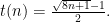
 ;
;  .
. — we’ll only need this formula to work when x is an integer. So, for example,
  , and the index of 9.875 in the triangular number sequence, whatever that means, is between 3 and 4. But
  .
.
 . Take the number of triangular numbers less than
  , and subtract the number less than
  ; there are 6 triangular numbers less than 25, namely 1, 3, 6, 10, 15, and 21. And
  . Thus
  , indicating the triangular number 21. So at long last we have the formula
 .
.
 has period 12, each period containing five 2s and seven 1s. But this can’t hold, not unless
  . In fact
  . (Conflict-of-interest disclosure: I know Jancsy, and I went to college with Yglesias’ wife.)
 .
. God plays dice