I’m reading John R. Taylor’s textbook An Introduction to Error Analysis: The study of uncertainties in physical measurements. This is meant for people taking introductory physics lab classes, but it never hurts to revisit these things. I actually double-majored in math and chemistry in college. It’s fun watching the contortions that chemists go to to avoid math.
Anyway, measurements come with uncertainities: that is, they have the form 


– that is, the variances attached to the measurements add. Similarly, for differences,
. For example,
and
. Note that the error for the sum and the difference are the same – but for the difference, the error is relatively much bigger.
- To find
, start by finding the fractional uncertainties
and
. Then the squares of the fractional uncertainties add: the fractional uncertainty of the product is
. The same fractional uncertainty holds for quotients. For example, the fractional uncertainty in
is
, and that in
is
. So the fractional uncertainty in their product is $\sqrt{(0.133)^2 + (0.15)^2 = 0.201$. Thus we have for the product
and for the quotient
.
- Perhaps one learns rules for dealing with powers, logarithms, and the like. These are all easily derived from the rule
.
For example,


In this case, the fractional uncertainty becomes the absolute uncertainty in the logarithm. If we know a number to within ten percent, we know its log to within 0.1 unit.

But implicit in the rules for sums, differences, products, and quotients is the idea that the errors 


So what can we do? In this particular case it’s not hard to rewrite as
where 





Alternatively, we think that 
![0.5 \pm 0.011 = [0.489, 0.511]](https://s0.wp.com/latex.php?latex=0.5+%5Cpm+0.011+%3D+%5B0.489%2C+0.511%5D&bg=ffffff&fg=000000&s=0&c=20201002)
But we are not guaranteed that our rewriting trick will always work. What else can we do? I’ll address that in a future post.
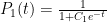

 . Furthermore
  , where
  is the number of students; solving gives
  .
.
 denotes the odds of
 denotes the event of not having heard yet. Typical pass rates at the time I was there were perhaps 3 out of 4, so
  . The conditional odds are therefore
 and
and  . So, after some algebra,
 . So the longer you go without hearing the news of someone’s exam outcome, the more likely it is that it’s bad news.
 and
and  , and replace with
  , where some possible choices of
  (
( (
( (
( (
( . And say we start with the numbers 2, 3, 6, 7. Then we could choose to do the replacement as follows. In each case the two bolded numbers are replaced by one.
 , which we can rewrite as
 , as computing the product
  by combining two factors at a time; of course the order doesn’t matter.
 , if we start with
  . With
  , we get
  . The result with
  is a little harder to see but if we start with
  we eventually get
  . This is a bit easier to see if we realize that
  ; therefore applying
  and
and  ; iterating these functions will just give the sum or the product of the original numbers. But what other nontrivial examples are there? Can you say what all of them are?
 .
. ways; here order matters.
 .
. of having each vowel occur exactly once. For
  I give those probabilities in the following table:

