An issue of sampling bias: doctors think people are sicker than they actually are, because most of the patients they see are sick. This is also known as the “clinician’s illusion”. Say you’re a doctor, and you have six “well” patients that you see once a year and one “sick” patient that you see once a month. Then out of your eighteen annual appointments, two-thirds will be with “sick” patients even though only one-seventh of your patients are sick! Patricia and Jacob Cohen wrote about this in 1984; here’s a recent explanation from a web site about addiction.
This is also a hazard of teaching: and perhaps related to the “80-20” rule: you spend 80 percent of your time dealing with 20 percent of the students. Certainly grading feels this way to me, since I teach classes where the questions generally have “right” answers, and I give partial credit – my impression of the average student is probably less favorable than the actual average student. The ones who get things right are easy to grade, so they take up less time than the ones who get things wrong, since I have to read their wrong answers carefully to decide where they went wrong. Perhaps grading feels less like this on more open-ended assignments. I’d be interested to hear.
Another educational example is that by simply making all classes at an institution the same size, one can reduce the average class size experienced by students without actually having to hire more faculty. Say your institution has one class of thirty students and one of sixty. Then if you pick a student uniformly at random, one-third will say “there are thirty students in my class” and two-thirds will say “there are sixty students in my class”, for an average of (1/3)(30)+(2/3)(60)=50. If you rebalance the classes to have forty-five students in each class, then the average class size experienced by students is 45. (The average class size experienced by students, by the way, is always greater than or equal to the average class size experienced by instructors, with equality if and only if all classes are the same size.)
Finally: how many children, including you, did your mother have? The average, averaging over women, is somewhere around 2 in the US. But say that the proportion of women having i children is 



Let 


 such that their mean and the mean of their squares are both integers. (Alternatively, their sum and the sum of their squares were both multiples of 5.) What are the chances of that?
 , so their sum is
  and their sum-of-squares is
  , both divisible by 5.
 . In fact one-fifth of the squares are divisible by 5; two-fifths are one more than a multiple of five; two-fifths are one less than a multiple of five.
 . This happens with probability
  .
. . This happens with probability
  .
. .
. . The probability of this is the number of ways of choosing which of our five integers is one more than a multiple of 5 and which is one less — that’s
  — times the probability of getting a square that’s one more than a multiple of five, then one that’s one less, then three multiples of 5, which is $(2/5)(2/5)(1/5)^3 = 4/5^5$, for a total of $80/5^5$.
 . The probability of this is
  .
. , or exactly one-fifth! Is there a simple argument for this?
 , or that all five have the same remainder, which happens with probability
  . And these add up to…
  .
. . However,
  and
and  both have probability $6/125$, and
  and
and  both have probability $4/125$. I have no idea why things work out this way, as this is just the result of a brute-force calculation.
 : number of 1’s required to build
  .
. , which I’ll abbreviate as
  , or
, or  , which I’ll abbreviate as $2+2$. But the complexity of 6 is 5 (it’s
  and so the complexity of 7 is 6 (it’s
  ). 36 has complexity 7, since it’s
  .
. , and 15 has complexity 8 if subtraction isn’t allowed, but
  gives a complexity of 7 if subtraction is allowed. Not allowing subtraction makes computation easier, though — by only allowing addition, multiplication, and exponentiation we compute everything in terms of small numbers. Call the version in terms of addition and multiplication only
  , for “multiplicative complexity”.
 and compute the sums of their complexities; then we find factors of
  by trial division and do the same for products; then we check to see if
  th power.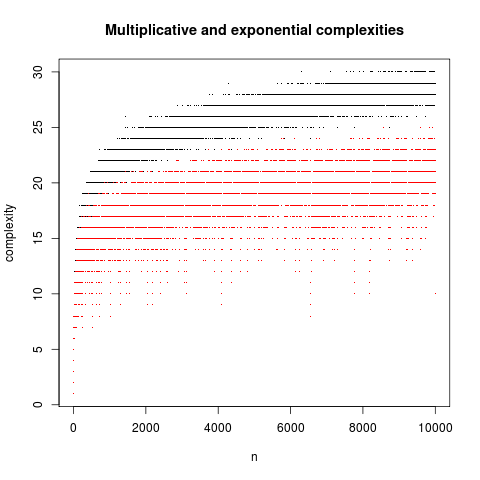
 ) while its multiplicative complexity is 24 (as
  ). If you divide out the logarithms — that is, plotting n against
  or
or  – all the black points lie between two horizontal line (around 2.8 and 3.6), and all the red points appear to lie below some horizontal line as well. There can’t be a horizontal line that all the red points lie above, other than the x-axis — if n has multiplicative complexity bounded above by c log n, then
  will have exponential complexity bounded above by
  . But powers and numbers very near them will be sparse, so perhaps almost all integers have exponential complexity above some logarithmic bound.
 ; one for
  ; and so on, in groups of 1000. We can do the same for the exponential complexities.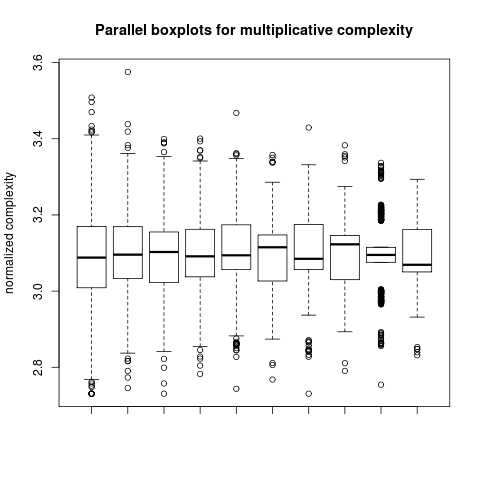

 rotations, where
  , then leaves tend to be arranged in such a way that they don’t cover each other up. I actually hadn’t known that Lucas numbers show up in phyllotaxis as well — the relevant angle is
  of a circle. And the whole thing comes from the mutual repulsion of the growing leaves.
 God plays dice