10 Turkish lira

The 10 Turkish lira note has math on it. I was inordinately amused by this when I discovered it yesterday, totally by accident when my girlfriend was showing me some money she picked up on a layover in Istanbul. In particular it includes a picture of Cahit Arf, whose work I am not familiar with but who appears to be one of the great Turkish mathematicians. This was basically domestic nerd sniping.

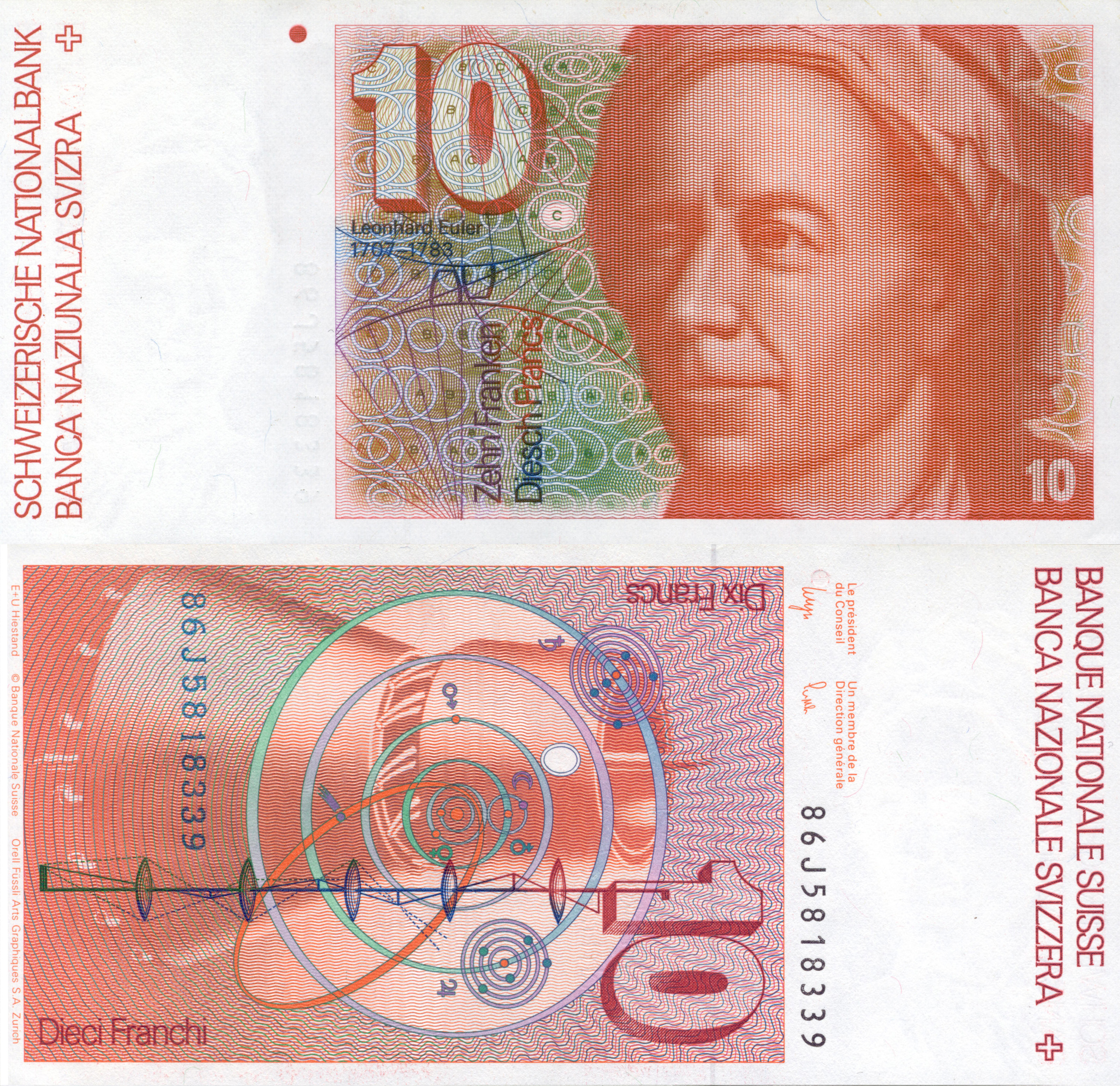
For more thorough coverage, see Jacob Bourjaily’s scientists and mathematicians on money. You may also be interested in purchasing portraits of Gauss. Newton was on the one-pound note when there was such a thing; the Euler ten-Swiss-franc note is out of print. Bourjaily collects notes with scientists and mathematicians on them and has a list of what he’s looking for; perhaps you can help him out?

Weekly links for September 9

Samuel Arbesman on the mathematics of parked cars, referring to a 2007 paper by Petr Seba “Parking in the city: an example of limited resource sharing”. (This gets more fun when you live in a city where lots of people have garages, but there is also lots of street parking. San Francisco is an example.)

Aaron Clauset and Ryan Woodard, Estimating the historical and future probabilities of large terrorist events. Via physics arxiv blog.

Secrets of Alice in Wonderland, alternating between the reading of pieces of the Alice in Wonderland stories by Cobi Smith and explanations of the underlying mathematics by David Butler. If you like this sort of thing you might be interested in The Annotated Alice: The Definitive Edition, by Lewis Carroll and Martin Gardner.

The Weatherman Is Not a Moron is an excerpt from Nate Silver’s new book The Signal and the Noise: Why So Many Predictions Fail-but Some Don’t

Making Math Matter: Differential equations in action

Udacity’s “Making Math Matter: Differential Equations in Action” by Jörn Loviscach and Miriam Swords Kalk began its premiere run yesterday. See the trailer below:

You need to know a little programming (the course uses Python); it wouldn’t hurt to know a little calculus. This looks like it should be fun.

I’m looking for a job, in the SF Bay Area. See my linkedin profile.

Mental math: how to convert Celsius to Fahrenheit

A lot of people know the formula for converting Celsius to Fahrenheit: multiply by 1.8 and add 32. Unfortunately this is somewhat annoying for mental-arithmetic purposes, because 1.8 is somewhat unwieldy. A few people suggest the rule of doubling the Celsius temperature, then adding thirty:
here, here, here. This is exactly correct at 10 Celsius / 50 Fahrenheit, and is off by one Fahrenheit degree for each five Celsius degrees . For example, it converts -20 C to -10 F (should be -4 F) and 40 C to 110 F (should be 104 F). So for weather-conversion purposes this is actually quite good, as 50 is right around the center of the “typical” weather range of 0 to 100. (I’m showing my roots here.)

For culinary purposes, I’ve seen the suggestion of doubling the Celsius temperature to get the Fahrenheit temperature. Solving the equation 1.8C + 32 = 2C gives C = 160, and 160 Celsius = 320 Fahrenheit, which is a fairly typical oven temperature.

As it turns out, in order to convert Celsius to Fahrenheit I don’t actually do the whole multiplying by 1.8 trick. Instead, I know what multiples of 5 degrees Celsius are in Fahrenheit:

C 0 5 10 15 20 25 30 35 40
F 32 41 50 59 68 77 86 95 104

I didn’t consciously memorize these. I knew the pair (0, 32) like everyone does (it’s the freezing point of water); (20, 68) is pretty common as room temperature. To get the others, note that the Fahrenheit temperatures go in steps of 9.

So to convert Celsius to Fahrenheit: say it’s 37 degrees Celsius. That’s near 35, so the Fahrenheit temperature must be near 95. But how far? Well, it’s two degrees Celsius warmer, or about four degrees Fahrenheit warmer; figure 1 Celsius degree is 2 Fahrenheit degrees. So 37 Celsius is 95 + 4 = 99 Fahrenheit. The truth is 98.6, which isn’t body temperature anyway. (You know that the whole 98.6 body temperature is an overly precise conversion of 37 Celsius, right? If not, now you do.)

Or right at this moment it’s 18 degrees Celsius in San Francisco. 20 Celsius is 68 Fahrenheit; it’s two degrees Celsius cooler than that, or about four degrees Fahrenheit. So 18 Celsius = 68 – 4 = 64 Fahrenheit.

In general, to convert Celsius to Fahrenheit, the method is as follows:

  • first, take the closest Celsius temperature from the first row of the table. Get a rough conversion into Fahrenheit from the second row.
  • for each degree Celsius you are above or below this approximation, add or subtract two Fahrenheit degrees from your rough conversion

The second step contributes an error of (2 – 1.8) = 0.2 degrees Fahrenheit for each Celsius degree of error — but no matter the starting Celsius temperature, one of the table entries is within two degrees of it, so we get an error of at most 0.4 degrees. If we’re rounding to the nearest integer anyway, who cares?

A simpler version is to only use every other column of the table; then you may end up with errors of as much as a whole degree.

(I didn’t realize this was what I was doing until I realized a few days ago that I could do these conversions in my head, and found myself trying to explain what I was doing. It would be harder between 0 and 32 F, because Celsius and Fahrenheit have opposite signs there, but I live somewhere now where it never gets below freezing.)

I’m looking for a job, in the SF Bay Area. See my linkedin profile.

Weekly links for September 2

What does the cone of uncertainty for hurricanes actually mean?

Is soccer sabremetrics coming?

Are we reaching a saturation point for scientists?

Google earth fractals

From xkcd, what if everybody only had one soulmate?

Skip Garibaldi wrote in Mathematics Magazine, in 2008, Somewhat more than governors need to know about trigonometry.

Jeremy Kun, K-Nearest-Neighbors and Handwritten Digit Classification.

The Dot and the Line: A romance in lower mathematics, an animated short film after the book of the same name by Norton Juster

Vi Hart doodles conic sections, cardioids, and so on. (Embedded in this is an interesting commentary on matheamtics education.)

Prime factorization sweater.

Tuesday, September 4 in Berkeley: “Alan Turing: A centenary celebration”

This Tuesday evening, September 4, MSRI is hosting a public lecture Alan Turing: A Centenary Celebration. Andrew Hodges, author of Alan Turing: The Enigma , will be giving a lecture, which will be followed by a panel discussion by Martin Davis (Courant Institute, logician), Hodges (University of Oxford), Don Knuth (Stanford University, computer science), Peter Norvig (Google, computer science), Dana Scott (Carnegie Mellon University, logic/CS), and Luca Trevisan (Stanford University, computer science).

And for those of you like me who don’t have cars, it’s at Berkeley City College! Right near BART! No need to trek up into the hills.

I’m looking for a job, in the SF Bay Area. See my linkedin profile.

Weekly links for August 26

Einstein, The cause of the formation of meanders in the coursers of rivers and of the so-called Baer’s law. via metafilter

The BBC looks at mathematical knitting.

Is the hot hand real?

James Tanton has a sequence of videos on things counted by Fibonacci numbers: part one, two, three. (This is a bit old – April 2012 – but I’m going through a backlog of links.)

Peter Norvig of Google speaks about mathematical models for language, at the Museum of Mathematics.

MIT’s 2011 Simons Lectures by Steven Strogatz: Coupled oscillators that synchronize themselves, Social networks that balance themselves, Blogging about math for the New York Times.

An interview with Grigori Perelman (and a description of the stakeout that led to it).

I found this somewhat by accident, while looking for something else: Andrew Ranicki’s page of topological baked goods (and some other novelties).

Jesus was a descendant of David, says the Bible, but so was everyone else alive at that time.

From Grantland, some new-school NFL statistics.

Norm Matloff has written a textbook, freely available online, From Algorithms to Z-Scores: Probabilistic and Statistical Modeling in Computer Science.

From Steven Strogatz on twitter, a couple links to good chaos resources: Michael Cross’s Caltech lecture notes and Chaos: Classical and Quantum by P. Cvitanovic, R. Artuso, R. Mainieri, G. Tanner and G. Vattay.

I’m looking for a job, in the SF Bay Area. See my linkedin profile.

Two well-known mathematicians died this week

The first is William Thurston. I’m not a geometer, so I’ll just do a roundup of some interesting things I’ve seen:

John Horgan, How William Thurston (RIP) Helped Bring About “The Death of Proof”.

Edward Tenner in The Atlantic.

Terry Tao briefly summarizes some of Thurston’s work.

New York Times obituary (Leslie Kaufman). The headling here is “William P. Thurston, Theoretical Mathematician, Dies at 65; I’ve seen some people say that the word “theoretical” is superfluous here.

Daina Taimina‘s pictures and remembrances.

Cornell’s memorial site.

Peter Woit.

metafilter.

A couple videos:

And a couple bits of metamathematics:

Thurston, On Proof and Progress in Mathematics

Thurston’s answer to the MathOverflow question What’s a mathematician to do? (to contribute to mathematics). “The product of mathematics is clarity and understanding.”

The second, somewhat closer to my background as a combinatorialist, is Jerry Nelson.

Weekly links for August 19

The rise and fall of scoring in baseball, a visualization from Smithsonian. (Could this have something to do with the recent surfeit of perfect games?)

Joseph Gallian, in the Notices of the AMS, writes that undergraduate research in mathematics has come of age. (He’s the one behind the Duluth REU.)

Rod Carvalho has reposted, with some cleanup a Google Buzz post by Terence Tao on classical deduction and Bayesian probability. Short version: “one can view classical logic as the qualitative projection of Bayesian probability, or equivalently, one can view Bayesian probability as a quantitative refinement of classical logic.” (How’d I miss this the first time around? Oh, right, I was in the crucnh time on my dissertation.)

How to build a teleportation machine: intro to qubits. (On a related note I’ve been enjoying Umesh Vazirani’s Coursera course Quantum mechanics and quantum computation.

Friendship networks and social status, by Brian Ball and M. E. J. Newman. Quick version: observe which friendships go unreciprocated in high schools. Assume that if A lists B as a friend but not vice versa, then B likely has higher “social status” than A. This gives a ranking by social status.

Vector Racer is an online implementation of the game of Racetrack. (Via Metafilter.)

In the fall of 2001 Jim Propp (then visiting Harvard from Madison, currently at UMass Lowell) taught a course on algebraic combinatorics for undergrads with the explicit goal to “bring [undergraduate!] students to the point of being able to conduct original research in low-dimensional combinatorics, using algebraic and bijective techniques.” Why am I mentioning an eleven-year-old course? Because the videos are available online (see link above). (You’ll need RealPlayer.)

A traveling salesman variant from Twelve Mile Circle: what’s the shortest (in mileage) driving route that hits all of the 48 contiguous states?

Anand Rajaraman and Jeff Ullman’s book Mining of Massive Datasets is downloadable online from the authors. There’s also a hardcopy. (If you pay attention to these sorts of things, it won’t surprise you to learn that the publisher is Cambridge University Press.)

Montgomery County [Maryland] Math Team elevates math to competitive sport, from the Washington Post Magazine.

A mathematician goes to the beach, from Gregory Buck, at the New Yorker culture desk.
I’m looking for a job, in the SF Bay Area. See my linkedin profile.